Own a flat in Porvorim or a villa in Assagao or an old family house in a quiet Bardez village? One bill follows you around no matter what: Goa property tax. It is small next to the price of the property itself and that is exactly why people forget about it. Then a buyer asks for the last five receipts. Or a bank wants clean paperwork. Or a panchayat sends a notice. Suddenly a minor chore turns into a month of running around.
This guide explains how Goa property tax works in practice. You will learn who collects it and what the numbers look like and how to pay without losing a day at a government office. Whether you live in Goa or manage your property from Bengaluru or Dubai you should find something useful here.
What Is Goa Property Tax and Who Has to Pay It?
Goa property tax is an annual charge on buildings. It is collected by the local body where the property stands. The money goes toward things you use every day such as street lighting and drainage and garbage collection and small civic repairs.
Anyone who owns a built structure is expected to pay. That covers houses and apartments and shops and godowns and sheds. It also covers properties that sit empty. A flat you only visit at Christmas still gets a bill. A house you have shut up for years is still on the register.
One point trips up first-time buyers. The tax is mainly assessed on the building and not the land. That means its size and construction type and how it is used. Land records are maintained separately. So buying a plot does not automatically put you in the tax system. The bill usually starts once there is a structure and the local body has it on record.
Goa House Tax: Why the Name Changes by Location
Ask a local about “property tax” and you may get a blank look. Ask about Goa house tax and the conversation moves quickly. Both terms describe the same levy. “House tax” is simply the everyday phrase and it shows up on most receipts and notices.
What matters more is who collects it. Three kinds of bodies are involved in Goa:
- Village panchayats handle most rural and semi-rural areas.
- Municipal councils cover towns such as Mapusa and Margao and Ponda and Mormugao.
- The Corporation of the City of Panaji looks after the capital.
Each body has its own office and its own records and its own way of assessing buildings. Panchayats tend to look at construction type and built up area. Municipal bodies lean more on location and use and rateable value. Two similar houses a few kilometres apart can receive noticeably different bills. Never assume a neighbour’s number applies to you.
Property Tax Rate in Goa: How Local Bodies Set the Number
There is no single statewide figure. The property tax rate in Goa depends on where your building is and what it is made of and how it is used. Rural panchayat slabs are usually quoted per square metre of built up area and they vary by construction type.
The table below shows indicative annual ranges commonly cited for panchayat areas. Treat them as a starting point and not a final quote.
| Type of structure | Indicative rate (per sq. m per year) |
|---|---|
| New residential house with RCC | ₹5 to ₹8 |
| New house with Mangalore tiles and masonry walls | ₹2 to ₹4 |
| New house with mud walls | ₹0.50 to ₹1 |
| New garage or shed or cowshed attached to a house | ₹0.50 to ₹1 |
| Shop with RCC | ₹10 to ₹15 |
| Shop with Mangalore tiles | ₹5 to ₹10 |
| Shop with mud walls | ₹3 to ₹5 |
Older houses are treated differently. Many homes built before 1990 fall under special provisions with capped or fixed amounts. Some small traditional or social housing is reported to carry a flat yearly figure of around ₹250. Municipal areas follow a different logic based on annual rateable value so the numbers above will not match a Panjim or Margao bill.
The takeaway is simple. The property tax rate in Goa is local. Confirm the current slab with your panchayat or municipal office before you budget.
Property Tax Calculator Goa: Working Out Your Bill by Hand
Many owners search for a property tax calculator Goa and end up disappointed. There is no single official calculator that covers every panchayat and municipality. The good news is that the maths is easy for most panchayat properties.
The basic formula looks like this:
Built up area (sq. m) × applicable rate per sq. m = annual house tax
Here is a quick example. Say you own a new RCC house with 150 square metres of built up area and your panchayat applies a rate between ₹5 and ₹8:
- Lower end: 150 × 5 = ₹750 per year
- Upper end: 150 × 8 = ₹1,200 per year
If the same house has a 20 sq. m attached garage at ₹0.50 to ₹1 you add another ₹10 to ₹20. That is the whole exercise. These numbers are only illustrations. Your own bill depends on the slab your local body actually applies.
If your property is in a municipal area a property tax calculator Goa is less useful because assessment depends on rateable value. In that case ask the municipal taxation department for your assessment sheet and check how the figure was reached.
Goa Property Tax Online: Paying Without the Queue
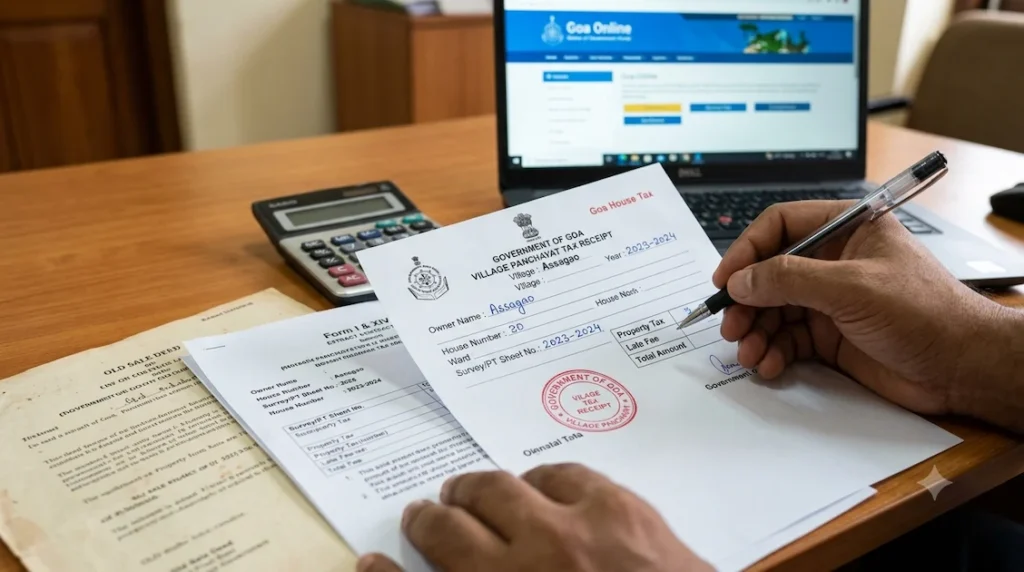
You no longer need to stand in line to clear your dues. Goa property tax online payment is available through the state’s Goa Online portal for many municipal and panchayat areas. Some municipal councils also run their own payment pages.
Here is the usual process:
- Open the official Goa Online portal and log in or register.
- Find the property or house tax service under the revenue section.
- Select your municipality or panchayat.
- Enter your survey number or PT sheet or chalta number along with your ward and house number.
- Check the amount shown and pay through the available digital options.
- Download the receipt and save a copy as a PDF.
A word of caution from experience. Not every property appears in the online database. Older houses and recently built structures and recently sold properties are the usual culprits. If your house number does not show up the problem is almost always in the local body’s records and not on your end. A visit to the panchayat secretary or the municipal tax counter is the fix. Once the record is updated the Goa property tax online route works normally.
How to Find Your Assessment Number
You cannot pay without it so find it first. There are two ways:
- Online: Use the property information service on the portal and select your taluka and village. Then search with your survey number or PT sheet or chalta number.
- In person: Visit your panchayat or municipal office with your sale deed and your Form I & XIV extract or an old electricity or water bill. Ask for the assessment number.
Write it down somewhere safe. Owners who keep it handy save themselves a lot of back and forth every year.
Due Dates and Late Fees: What Happens If You Skip
Billing cycles differ by body. In Panaji bills typically go out once a year with payment expected around April and May. Panchayats and other councils may follow their own calendars so check locally instead of assuming.
Late payment usually attracts interest or penalties and the amount grows the longer you wait. Beyond the money unpaid Goa house tax causes practical headaches:
- You may be unable to get a tax clearance when selling.
- Some NOCs and service requests can be held up.
- The local body can issue demand notices and in serious cases start recovery action.
Dues also tend to pile up across years. A three year backlog is far more stressful to clear than a single bill.
Name Transfer and Old Houses and Unauthorised Extensions
These are the three situations where owners most often get stuck.
Transferring the name after a purchase. When you buy a house or flat the tax record often stays in the seller’s or builder’s name. You need to apply at the local panchayat or municipal office to have it changed. Carry your sale deed and identity proof and the last paid receipt. Doing this early avoids confusion later.
Ancestral and heritage homes. Plenty of Goan families still receive bills in the name of a grandparent or great grandparent. Before you sell or divide such a property get the record updated to the current legal heirs. It takes patience because old ledgers sometimes have to be searched by hand. It is still far easier than sorting it out in the middle of a sale.
Unauthorised extensions. A panchayat may charge house tax on a structure built without approval. Paying that tax does not make the structure legal. It is no substitute for a construction licence or an occupancy certificate or town planning approval. Treat the receipt as proof of payment and nothing more.
Why Goa Property Tax Receipts Matter More Than You Think
Keep every Goa property tax receipt in both digital and printed form. They come up more often than people expect:
- Selling a property: Buyers and their lawyers usually ask for recent receipts.
- Home loans: Banks may ask for proof that dues are cleared.
- Utility connections and NOCs: Some departments want updated tax proof.
- Inheritance and partition: Receipts help show a steady record of possession and payment.
A simple habit works well. Pay each year and download the receipt. Name the file with the year and property and store it in cloud storage. If you are an NRI or an outstation owner set a yearly reminder and ask someone reliable to check the local bill. Notices sent to a Goa address can easily be missed.
Final Thoughts
Goa property tax is not complicated but it rewards people who pay attention. Know which body collects your bill and understand how the property tax rate in Goa applies to your building. Keep your assessment number handy and pay on time. Use Goa property tax online whenever your record is linked and fix any record problems at the local office before they become sale problems. A little organisation each year keeps your Goa house tax record clean and your property easy to sell or rent or pass on.
Frequently Asked Questions
Yes. A building that is empty or unused still appears on the register and the tax applies.
In everyday use yes. “House tax” is the local phrase while “property tax” is the broader term used online. The levy is collected by the panchayat or municipal body where the building stands.
If your property is linked to the online system you can pay from anywhere with a working payment method. If it is not linked you will need someone to visit the local office for you or contact it directly.
No. The rate depends on your panchayat or municipality and the type of construction and how the building is used.