Goa sells a dream. A quiet plot. A short drive to the beach. A home you can call your own.
But many buyers tell a different story. The “ready” plot turned out to be orchard land. The layout was approved only on paper. The developer took a token amount and went quiet.
The RERA Act in Goa was made to stop this.
The law came into force on 1 May 2017. Its full name is the Real Estate (Regulation and Development) Act, 2016. This guide explains how the RERA Act in Goa works and how it protects you. It helps plot buyers and investors alike.
You will also see how Goa RERA runs the system. You will learn how to do a RERA registration check in Goa. And you will learn how plots are treated.
What the RERA Act in Goa Changed
Before 2017, no one watched over the property market. If a builder cheated you, you went to a consumer court. Cases took years.
Buyers faced the same problems again and again:
- Plots and flats handed over late
- Layouts that differed from the plan
- Money moved to other projects
The RERA Act in Goa fixed this. The state set up its own authority. The Government of Goa notified the state rules in November 2017. The online portal was launched in 2018.
The table shows the rules buyers care about most.
The RERA Act in Goa at a glance
| Rule | What the law says | What it means for you |
|---|---|---|
| Registration | Projects over 500 sq m or with more than 8 units must register before any advertising or sale | Check the project on the Goa RERA website before you pay |
| Escrow account | 70% of buyers’ money goes into a separate account | Your payment builds your project, not another one |
| Carpet area | Flats are sold by usable floor area | You don’t pay for shared space like lobbies and stairs |
| Advance limit | Builder can take at most 10% before a registered agreement for sale | Less money at risk early in the deal |
| Quarterly updates | Builder uploads progress reports every quarter | You can track the project from home |
| Structural defects | Builder repairs defects free for 5 years after possession | Repair costs stay with the builder |
| Delay compensation | Refund with interest, or monthly interest if you stay | A late builder pays for the delay |
| Complaint timeline | Authority aims to decide within 60 days | Faster than the old court route |
Two more facts help:
- Goa RERA registers projects and agents. It also hears complaints.
- A higher body, called a tribunal, hears appeals. So you can challenge a bad decision.
The law also demands honesty. A builder cannot promise one thing and register another. If they do, they can be fined.
What is carpet area? It is the floor space inside a flat. It does not include walls, balcony or terrace. Before this law, many buyers paid for shared space too. Carpet area does not apply to plots. But the honesty rules do.
Each state runs the law its own way. So fees and timelines can differ.
RERA Benefits for Plot Buyers, Explained Simply
The RERA benefits for plot buyers come down to three things:
- You can see what you are buying.
- Your money is safer.
- You can complain if things go wrong.
See what you are buying. A registered project shares its layout, approvals, land details and end date online. What the seller tells you must match this record. A builder who lies can be fined. The brochure no longer has the last word.
Your money is safer. Before you sign a registered sale agreement, a builder can take only 10 percent of the price. After that, most of your payments go into a separate bank account. This keeps builders from using your money on other sites.

You can complain. Say your plot is not ready on the promised date. You have two choices. You can leave and get your money back with interest. Or you can stay and get interest for every month of delay. The authority tries to decide complaints in 60 days. That is much faster than a court.
Investors get these protections too. The law treats anyone who books a plot or flat as a buyer. So the RERA benefits for plot buyers apply if you buy to invest.
Here is a simple example. You book a plot in a new layout. The promised date passes. The builder says nothing. Before RERA, you sent emails and hoped. Now you can point to the date on the portal. You can ask for interest. And you can file a complaint.
But the RERA benefits for plot buyers work best with good records. Keep your agreement, allotment letter and every receipt in one folder.
How to Do a RERA Registration Check in Goa
Many people skip this step. Do not. A RERA registration check in Goa takes about ten minutes.
Follow these steps:
- Ask the seller for the project’s RERA number. It should be on the brochure and the agreement.
- Open the official Goa RERA website. Type the address yourself. Do not click links sent on WhatsApp.
- Search by project name, builder name or RERA number.
- Read the page with care.
- Compare it with what the seller told you.
Watch for red flags:
- The registration has expired.
- The seller says it is “applied for”. That is not the same as registered.
- The number shows a project in another town.
Never trust a screenshot from the seller. Do your own RERA registration check in Goa. Do it again before your final payment. A project’s status can change.
Here is what to read on the project page:
- Validity date: An expired registration means the project may not be legal to sell.
- Approved layout: It should match what you are shown.
- Land owner: The builder must have the right to develop the land.
- Survey number: It should match the number in your land record.
- End date: You need this to claim money for delay.
- Bank details: They show where your money should go.
- Complaints: They show how the builder treats buyers.
Take a dated screenshot of the page. It proves what was registered on the day you paid.
Goa RERA: What Is Different in the State
Goa has its own regulator. It is the Goa Real Estate Regulatory Authority, based in Panaji. Its website lists registered projects, agents and complaint orders.
Goa RERA follows the central law. But the state sets its own fees, steps and interest rates.
Keep three things in mind:
- Agents must register too. Ask yours for their number.
- Interest works both ways. The same rate applies to a late builder and a late buyer. State rules usually link it to SBI’s benchmark lending rate plus two percent.
- Goa RERA does not replace local approvals. Check those with the Town and Country Planning (TCP) Department and the local panchayat or municipality.
The state website keeps all the facts in one place. You can see the project details. You can see if the builder filed updates. And you can see if buyers have complained.
Many Goa plot buyers live in other cities or abroad. The portal helps them most. You can run a RERA registration check in Goa from anywhere.
A quiet project is also a warning sign. Has a project gone silent for months? That tells you a lot.
Plotted projects are common across North and South Goa, from Pernem and Bardez to Salcete. Whichever area you like, search Goa RERA first. Confirm the project’s status before you pay any token money.
RERA Rules for Plots in Goa: Do They Cover Land?
Many buyers think RERA is only for flats. That is not true.
A developer may split land into plots and add roads and drains. If the land is above 500 sq m, the project comes under the law. Then the RERA rules for plots in Goa apply. They cover registration, a separate bank account, shared details and pay for delay. It works just as it does for flats.
Plots and flats follow the same basic rules. But some details differ:
- Registration: Flat projects register above 500 sq m or with more than eight units. Plot projects register when land above 500 sq m is split into plots.
- Bank account and repairs: The 70 percent rule and the five-year repair promise apply to both. For plots, repairs cover roads and drains.
- What you buy: With a flat, you buy the carpet area. With a plot, you buy a marked piece of land with services around it.
- Key paper: For flats, it is the approved building plan. For plots, it is the approved layout plan with boundary marks.
- Main risk: Flat buyers fear building delays. Plot buyers should fear slow development and unclear boundaries.
There is one catch. A single plot sold as is, with no development, may fall outside the law. It depends on how the project is set up.
So do not guess. Ask the seller for the RERA number in writing. Then check it online.
Before you rely on the RERA rules for plots in Goa, ask the seller three questions:
- Has the local authority approved the layout?
- Is the project registered? What is the number?
- Who builds the roads, drains and power lines after I pay?
Clear answers in writing are a good sign. Vague answers need a second look.
Goa Land Checks That RERA Does Not Cover
Even when the RERA rules for plots in Goa apply, RERA checks the project. It does not check the land’s full history. Goa has its own land rules. So add these checks:
- Form I and XIV: This is the land record. It shows the owner, the occupant and the type of land. Get a fresh copy for your survey number.
- Zone: Ask the TCP Department for a zoning certificate. Not every plot can be built on.
- Conversion Sanad: Agricultural land needs a Conversion Sanad before you can build on it. Ask to see it. Check that the survey number matches your plot.
- Comunidade land: If Form I and XIV name a Comunidade as the owner, stop. Take legal advice first.
- Coastal rules: Plots near the sea may fall under CRZ rules. You may need coastal clearance before you build.
- Slope: Steep land is a problem. Building on land with a slope above 25 percent is not allowed in Goa.
- Title opinion: Ask a Goa advocate for a written opinion. Goa follows its own civil code in family property matters, so this step counts.
NRIs need one more check. Under FEMA rules, NRIs cannot buy agricultural land or farmhouses. Ask an advocate before you pay.
A RERA registration check in Goa does not prove any of this. Do both.
Tips for Investors
Investors worry about returns. That is fair. But how you buy matters as much as what you earn.
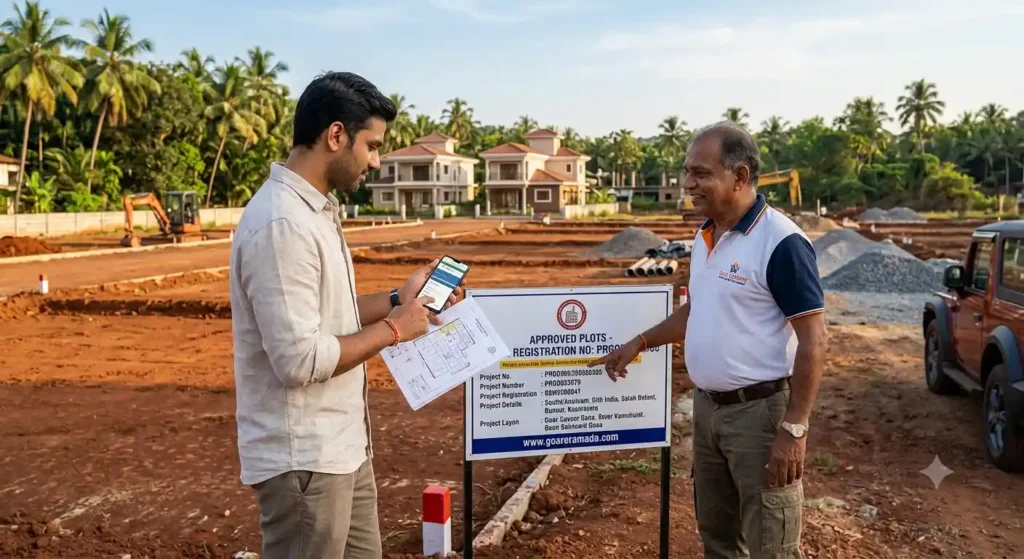
Follow these habits:
- Read the sale agreement line by line. Check the end date, payment plan and penalty terms.
- Look up the builder’s past projects. Did they finish on time?
- Pay through your bank. Keep every receipt.
- Trust the record, not a phone promise.
The RERA Act in Goa cannot protect you from a weak market. It cuts the risk in the deal, not in the price. So do your own research on the area and demand. Think of the RERA benefits for plot buyers as a safety net, not a guarantee of profit.
Plan to sell later? Your buyer will run the same checks. A plot with clean records and receipts sells faster. It also needs fewer discounts. A buyer who knows the RERA Act in Goa will ask for those papers on day one.
Common Mistakes Buyers Make
Even careful buyers slip up. Avoid these mistakes:
- Thinking registration is enough. A RERA registration check in Goa does not prove the land title or the zone.
- Believing an agent who says “all is registered”. Search the Goa RERA website yourself.
- Buying a cheap orchard or agricultural plot on the promise of a later conversion.
- Signing without reading the penalty and cancellation terms.
- Paying part of the price in cash. Then you have no proof.
- Thinking the RERA rules for plots in Goa cover every piece of land. They cover only developed, eligible layouts.
- Treating the RERA Act in Goa as a promise of safety. It gives you facts and remedies. You still must read and check.
What to Do If a Builder Breaks the Rules
Take these steps in order:
- Send a written notice. Keep a copy.
- If the reply is poor, file a complaint online with Goa RERA. Attach your agreement, receipts and messages.
- The authority hears both sides and gives an order.
- If you disagree, appeal to the tribunal.
The law lets buyers complain together. You can file as a group or through an association. That often makes a case stronger.
Orders must be followed. A builder who ignores one can face penalties. The authority can order refunds. For serious cases, it can cancel the project’s registration.
Keep a tidy folder. Add the agreement, receipts, allotment letter, dated screenshots and a log of calls and emails.
Conclusion
If you take one thing from this guide, let it be the portal search. Ten minutes on the official website, a careful read of the agreement and a look at the land papers protect you better than any brochure. Start with a RERA registration check in Goa. Do it before you pay any token money. Whether it is a plot in Bardez or a flat in Salcete, the RERA Act in Goa gives you tools that earlier buyers never had. Use them. Keep every receipt. Ask questions until the answers match the record. A careful buyer is a safe buyer.
Frequently Asked Questions
Yes, for projects above 500 sq m or with more than eight units. Projects that already had a completion certificate when the law began were exempt.
Go to the official Goa RERA website. Search by project name or RERA number. Then compare the dates, approvals and layout with what the seller said.
Yes, if the project is registered or must be. The RERA rules for plots in Goa give the same core protection. You get shared details, a separate bank account and compensation for delay.
Safe payments, true details, and a refund with interest for delay.
Yes. Under the RERA Act in Goa, the authority can cancel it if the builder breaks the rules. The builder gets a chance to respond first. Then the authority can act to protect buyers.